The Secret Science of Marbling
Japan's Taste of Luxury
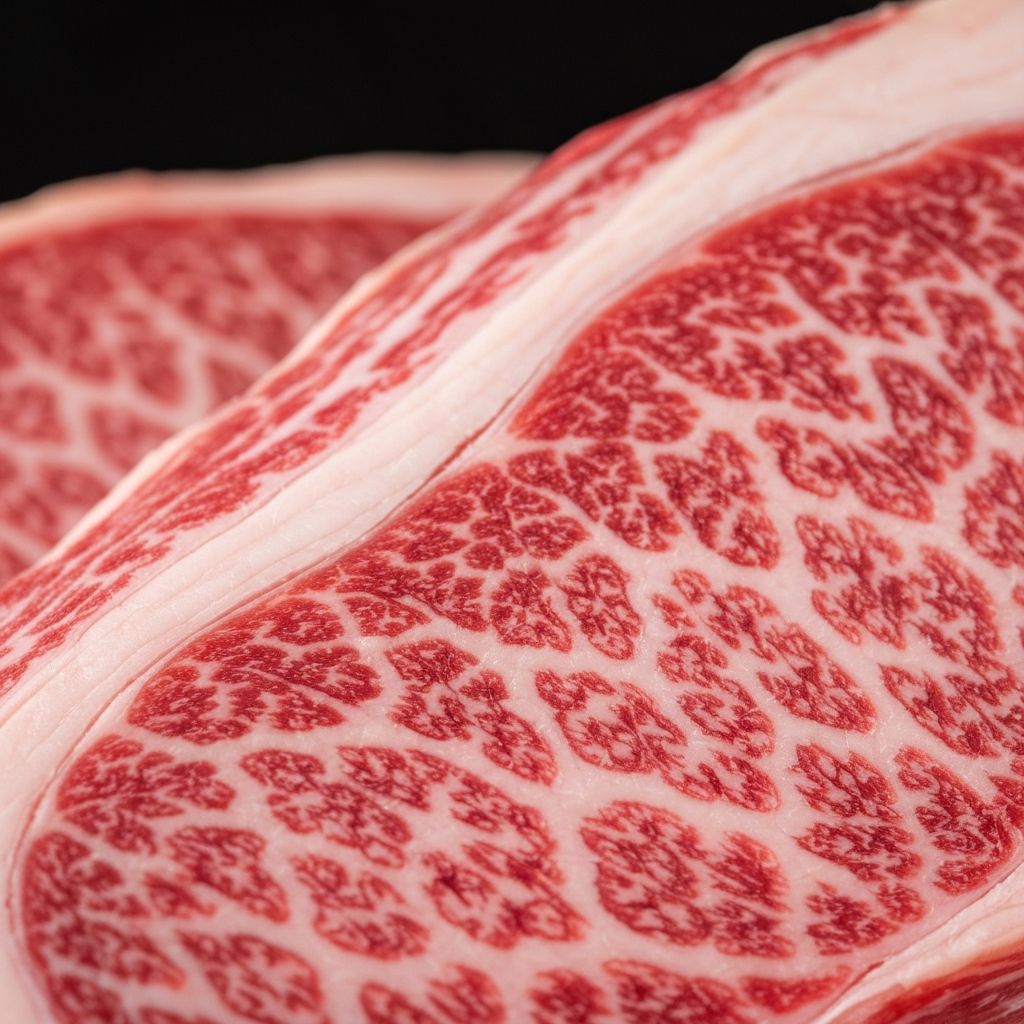
The first time you see A5 Wagyu, you pause. The meat looks painted — intricate webs of ivory fat running like rivers through crimson muscle. It's not random. It's art in biology.
This — the phenomenon called marbling or shimofuri (霜降り) — is the secret that makes Japanese Wagyu the world's most luxurious beef.
What Is Marbling, Really?
Marbling is the intramuscular fat that weaves through lean tissue, visible as thin white lines. But unlike ordinary fat, Wagyu's marbling is so fine and even that it melts at temperatures as low as 25°C (77°F) — lower than butter.
This means that when cooked, it liquefies instantly, coating the tongue with sweet, umami-rich oils — creating that signature melt-in-mouth texture.
Reference: Japan Meat Grading Association (JMGA)
The Genetics of Perfection
The marbling miracle begins in DNA. All true Japanese Wagyu come from one of four native breeds, but Kuroge Washu (Japanese Black) is the undisputed master of marbling.
This breed naturally produces more monounsaturated fat (oleic acid) and fewer connective tissues — the scientific reason it feels 'soft as silk.' Researchers discovered that Kuroge Washu cattle express higher levels of SCD (stearoyl-CoA desaturase) enzymes, which convert hard fats into softer, flavorful ones.
It's not just feeding — it's genetic symphony. A living blueprint perfected over centuries.
Reference: NARO Wagyu Research Division
The Marbling Score — Japan's Silent Language of Perfection
The Japanese Meat Grading Association (JMGA) grades every Wagyu carcass by Yield (A–C) and Quality (1–5). Within that Quality grade lies the Beef Marbling Standard (BMS) — a scale from 1 to 12.
Only BMS 8–12 earns the elite A5 designation — the apex of Wagyu artistry. To the Japanese, the grading isn't marketing — it's truth. Every number is a story written in texture, color, and balance.
Reference: JMGA Grading Guide
Flavor Beyond Fat — The Chemistry of Umami
True luxury is not richness — it's balance. Marbling provides the fat, but the flavor comes from amino acids: glutamic acid, inosinic acid, and oleic acid.
When heated, these compounds create the signature Wagyu aroma, known as Wagyu-kō (和牛香). It's the scent of sweetness, wood smoke, and umami — a fragrance so distinct that Japanese researchers have identified its molecular fingerprint.
That's why Wagyu isn't heavy. It's indulgent, yet disappears like memory.
Why It Matters to Wagyu.ae
At Wagyu Arabiya Trading LLC, we treat marbling not as decoration but as proof of devotion. Every cut we import from Japan — Miyazaki, Kobe, Ōmi, or Kumamoto — carries the mark of authenticity, certification, and Halal integrity.
Each line of fat tells a story — a map of care, a record of time. Our mission is to preserve that story through precise cold-chain logistics, ensuring what leaves Japan arrives in Dubai unchanged — perfect.
Because luxury isn't about how much you eat. It's about how deeply you feel it.